
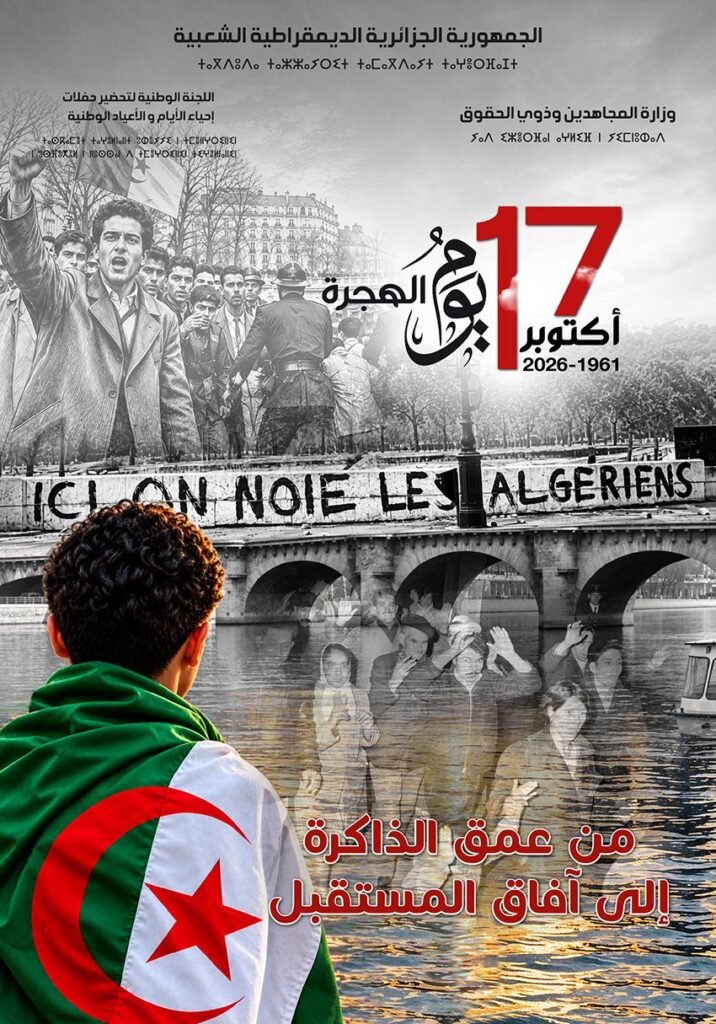
OF THE PARIS MASSACRE OF OCTOBER 17, 1961
As is customary, Algeria’s embassy in Dhaka stands ready to commemorate the 65thAnniversary of the October 17, 1961 Paris Massacres to pay solemn tribute to the hundreds of Algerian martyrs who fell victim to French colonial police brutality in Paris, while they were peacefully protesting against the discriminatory night curfew imposed exclusively on the Algerian Community in France on October 5 of the same year.
Observing this event as National Emigration Day, formalized by President Abdelmajid Tebboune in 2021, stands as a powerful testament to the Algerian state’s recognition of its diaspora. It honors both their ultimate sacrifices during the War of National Liberation and their continuous role in the country’s modern development.
By institutionalizing a nationwide minute of silence every October 17 since 2021, the Algerian Government established a permanent bridge between the nation’s past and its diaspora.
Despite the heavy toll of the horrific crackdown committed under Paris police under Maurice Papon, which has resulted in an estimated 100 to 300 martyrs, the massacre still had an inverse impact that significantly strengthened the Algerian Liberation Front (FLN) who was the primary target of the curfew, with the aim of weakening and isolating it –above all by cutting off the financial resources provided by the periodic contributions of Algerian workers in France.
Parallelly, the public massacre forced the French government to recognize the mass scale of domestic support for the self-determination movement. It proved that the FLN could effectively control and direct large segments of the population right in the heart of the French capital.
The scale of the state-instigated brutality fractured the French official narrative of ‘’ maintaining order ‘’. It generated internal shocks within certain French political circles and added to the mounting international pressure condemning France’s colonial tactics. This horrible event contributed to intensifying resistance and forced France to expedite diplomatic talks. Less than five months later, on March 18, 1962, the historic Évian Accords were signed, ending the war and officially paving the way for Algeria’s independence.
The October 17, 1961 massacre did have a significant, albeit delayed, positive impact on global solidarity for Algeria’s push for independence. By exposing the extreme violence of French colonial policy right in the heart of Europe, the event stripped away France’s ability to claim the Algerian conflict was merely as merely an internal ‘’ law and order ” issue. The global outrage and domestic political exhaustion following the massacre piled immense pressure on French authorities. It proved that containment was impossible, forcing France to expedite negotiation talks.
The courage of the Algerian independence movement and the exposure of French colonial brutality inspired anti-colonial and liberation struggles worldwide, intensifying the global push to dismantle European empires.
While the direct violence occurred in Paris, the severe repression of Algerian nationalist movements resonated across Africa and anti-colonial networks in Latin America as an example of state-sanctioned imperial violence.
France failed to hide the October 17, 1961, Paris massacre, and leaders later admitted the state’s violent role in the killings of Algerian protesters. The delayed official admission by the French government regarding the October 17, 1961 Paris massacre are considered incomplete by historians, human rights groups, and activists because France has consistently stopped short of issuing a formal state apology or classifying the tragedy as a ‘’ state crime’’.
The legacy of the October 17, 1961, Paris massacre remains deeply engraved in collective memory as a foundational testament to the sacrifices of the Algerian diaspora and a vital symbol reinforcing national cohesion and patriotism. The national cohesion forged during the November 1, 1954 Revolution remains the bedrock of Algerian solidarity and national development.
Algeria continues to be deeply shaped by its revolutionary history, particularly the legacy of the Algerian War of Independence. This patrimony serves as the foundational narrative for the assertive foreign policy on the global stage.
Just as the carnage of October 17, 1961, serves as a foundation for collective memory, this event-marking a dark chapter in France’s colonial history-continues to shape the future of the new Algeria.